What Is the Best CNC Centre Lathe from China?

Choosing the best Cnc Centre Lathe from China requires more than comparing prices or catalog photographs. Global demand is rising. Grand View Research valued the CNC machine market at approximately USD 88.7 billion in 2023, while Fortune Business Insights reported different figures because it used a different market scope. The difference matters. It shows why buyers should examine definitions, specifications, and evidence carefully.

A capable Chinese Cnc Centre Lathe should combine rigid castings, stable spindle performance, accurate ball screws, and dependable control software. In practical use, these details affect thread quality, surface finish, vibration, and cycle time. Check spindle power, chuck diameter, swing over bed, turning length, positioning accuracy, and repeatability. Also inspect factory testing records. ISO 230-2 testing, laser calibration, sample machining, and an acceptance test provide stronger evidence than marketing claims. A glossy brochure is not proof.

Masahiko Mori of DMG MORI has described machine tools as “the mother machines.” That perspective is useful here. The lathe shapes the reliability of every later production step. However, no single Chinese model suits every workshop. A compact hydraulic-parts supplier may value a 6-inch chuck and fast indexing. A heavy-equipment manufacturer may need greater torque, rigidity, and tailstock support. Service response, spare-part availability, operator training, and software compatibility deserve equal attention. Reports provide market direction, not a purchasing decision. Real trials remain essential. My caution is simple: the cheapest machine may become the most expensive after twelve months.
What Is the Best CNC Centre Lathe from China?

What Defines a CNC Centre Lathe and Its Main Applications

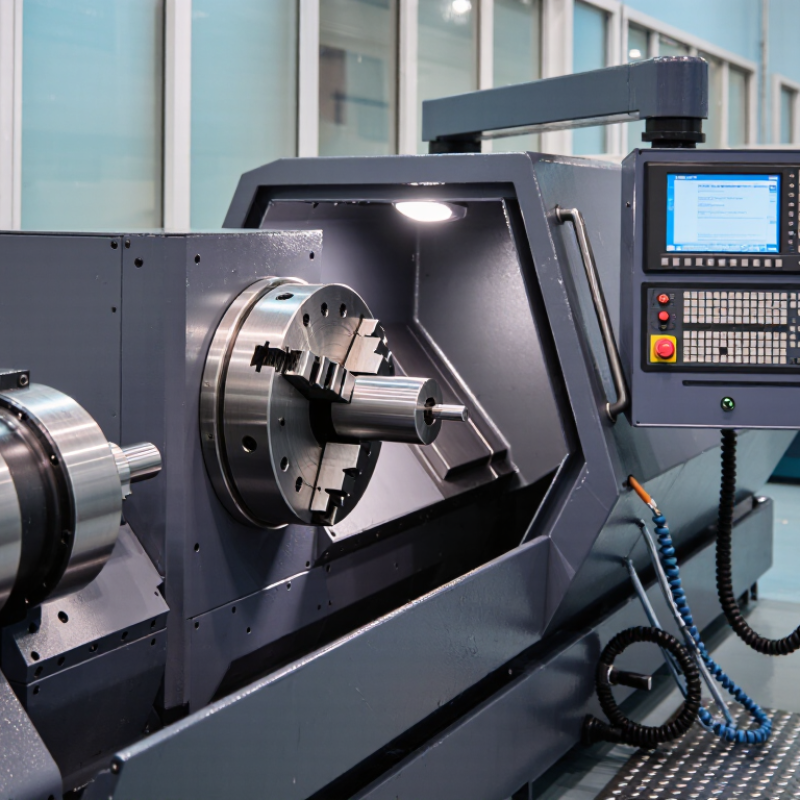
A CNC centre lathe is a computer-controlled turning machine built around a rotating workpiece and fixed cutting tools. The spindle holds bar stock or a prepared blank, while the turret positions drills, boring bars, and external turning tools. Its defining feature is controlled movement across several axes, guided by programmed coordinates and verified tool offsets. Unlike a manual lathe, it repeats profiles with consistent speed, feed, and cutting depth. Setup still matters greatly. A rigid frame helps. Accurate tooling matters too.

These machines produce shafts, bushings, pins, threaded parts, flanges, and other rotational components. They serve automotive, hydraulic, agricultural, energy, and general engineering workshops. CNC centre lathes are valuable for medium and high-volume production because one program can control repeated operations. Live tooling or a driven tool system can reduce secondary machining, depending on the configuration. However, complex parts may require additional equipment. That limitation is often overlooked.

When assessing a CNC centre lathe from China, inspect spindle accuracy, turret repeatability, guideway protection, and chip removal. Ask for cutting trials using material similar to your production work. Review electrical documentation, calibration records, training support, and spare-part availability. A polished demonstration is not enough. I have found that production stability depends on installation, operator training, and maintenance discipline as much as the machine itself. Price can attract attention, but measurable tolerances and dependable support deserve greater weight. The “best” machine is not automatically the largest or fastest.

Key Features to Compare When Selecting a Chinese CNC Centre Lathe

What Is the Best CNC Centre Lathe from China?

Selecting a Chinese CNC centre lathe should begin with production evidence, not catalogue price. Fortune Business Insights valued the global CNC machine market at about USD 88.5 billion in 2023. This expanding market offers more choices, but specifications still require careful verification. Match spindle torque to the material, not only spindle speed. Steel shafts may need strong low-speed torque, while aluminium parts benefit from higher rpm. Check the chuck diameter, spindle bore, axis travel, and bar capacity against your largest routine workpiece.

Accuracy needs practical testing. ISO 230-2 provides methods for checking positioning accuracy and repeatability. Ask for an acceptance test using a calibrated laser interferometer or ball bar. A 0.005 mm catalogue claim means little if thermal drift appears after four hours. Observe a trial cut. Look for stable surfaces, consistent dimensions, and clean chip evacuation. Small details matter, including coolant pressure, enclosure sealing, turret indexing time, and access to filters.

The control system should support your operators. Easy program transfer, tool-life monitoring, alarm records, and remote diagnostics can reduce avoidable downtime. The International Federation of Robotics reported 276,288 industrial robot installations in China during 2023, showing the direction toward connected production. Still, integration is not automatic. Confirm communication protocols and after-sales response times in writing. I would also calculate energy use per part, although buyers often overlook it. A faster lathe can become expensive when oversized motors, coolant systems, or repeated setup errors consume the savings.

Leading Types of Chinese CNC Centre Lathes for Different Production Needs

Choosing the best CNC centre lathe from China depends on production evidence, not catalog promises. Gardner Intelligence’s 2024 World Machine Tool Survey identified China as the largest machine-tool consuming market in 2023, representing roughly one-third of global demand. That scale supports broad machine choices, but quality varies between configurations and factories. Ask for acceptance-test records, spindle runout data, thermal compensation results, and sample parts cut from your material. Small details matter.

For short shafts, flanges, and repair batches, a flat-bed CNC lathe offers accessible tooling and simpler setup. A slant-bed turning center suits repetitive automotive or hydraulic work because its inclined bed improves chip flow and supports compact automation. China installed 276,288 industrial robots in 2023, according to the International Federation of Robotics’ World Robotics 2024 report. This automation trend favors lathes with reliable loading interfaces. Need driven tools? Choose a mill-turn center. It drills, mills, and turns one clamped part, reducing alignment errors. For slender electronic components, a Swiss-type machine provides guide-bushing support, although programming requires stronger skills.

Heavy-duty oil, energy, and construction parts need a rigid large-bore lathe, powerful spindle, and verified torque under load. The 2024 China Machine Tool Industry Association statistics also indicate a demanding domestic market, making after-sales response important. Confirm spare-part lead times, remote diagnostics, operator training, and local service coverage. Cost per part matters more than purchase price. A cheaper machine may lose money through idle time or unstable accuracy. I would request a 24-hour trial run. Real production is less forgiving than a showroom test.

What Is the Best CNC Centre Lathe from China? - Leading Types of Chinese CNC Centre Lathes for Different Production Needs

CNC Centre Lathe Type Typical Swing Over Bed Typical Turning Diameter Typical Turning Length Typical Spindle Bore Typical Spindle Speed Typical Motor Power Best Production Use Main Advantages Key Limitations Recommended Production Volume
Flat-Bed CNC Centre Lathe 360–800 mm 200–500 mm 500–2,000 mm 52–105 mm 2,000–3,000 rpm 7.5–30 kW General shaft, flange, bushing, and maintenance-part production Versatile setup, accessible work area, suitable for large and irregular workpieces Usually slower and less rigid than a slant-bed design for intensive automated production Low to medium
Slant-Bed CNC Centre Lathe 450–700 mm 250–450 mm 500–1,500 mm 52–86 mm 3,000–4,500 rpm 11–30 kW Precision components, automotive parts, hydraulic parts, and repeat production Good chip evacuation, strong rigidity, efficient tool access, and high process stability Higher purchase cost and more complicated access for some manual operations Medium to high
Economical 2-Axis CNC Centre Lathe 300–550 mm 180–320 mm 300–1,000 mm 45–80 mm 2,500–4,000 rpm 5.5–18.5 kW Standard turning, facing, threading, grooving, and small-batch job-shop work Lower investment, simple programming, and relatively easy operator training Limited milling capability and less flexibility for complex multi-operation parts Low to medium
Heavy-Duty CNC Centre Lathe 800–1,600 mm 500–1,200 mm 1,000–5,000 mm 105–260 mm 500–1,500 rpm 22–75 kW Large shafts, rollers, pressure-vessel parts, mining components, and energy equipment High structural rigidity, large workpiece capacity, and strong low-speed cutting torque Large footprint, higher energy consumption, and slower cycle times for small components Low to medium
Swiss-Type CNC Centre Lathe 150–350 mm 3–32 mm 50–300 mm Usually below 32 mm 6,000–12,000 rpm 3.7–15 kW Small, slender, high-precision parts for medical, electronics, and instrument applications Excellent support near the cutting point, reduced deflection, and efficient bar-fed production More specialized setup, smaller workpiece range, and higher programming complexity High
Y-Axis and Driven-Tool CNC Lathe 450–700 mm 250–450 mm 400–1,000 mm 52–86 mm 3,000–5,000 rpm 11–30 kW Turn-mill parts requiring cross-drilling, tapping, slotting, and off-centre milling Combines turning and milling operations, reduces setups, and improves positional consistency Higher machine cost, more complex tooling, and greater programming requirements Medium to high
Twin-Spindle CNC Centre Lathe 400–650 mm 200–400 mm 300–800 mm 42–80 mm 3,000–5,000 rpm 11–30 kW per spindle Parts requiring front-and-back machining, such as fittings, connectors, and automotive components Can complete multiple part faces in one cycle and reduce transfer or secondary operations More expensive maintenance, complex synchronization, and higher operator skill requirements High
Automatic Bar-Fed CNC Centre Lathe 300–500 mm 20–250 mm 50–500 mm 20–80 mm 3,000–6,000 rpm 7.5–22 kW Long unattended runs of repeat components made from bar stock Reduced manual loading, consistent cycle times, and improved machine utilization Bar-feeder space and setup are required; less suitable for one-off large workpieces Medium to high
Gang-Type CNC Centre Lathe 250–450 mm 100–300 mm 100–600 mm 32–65 mm 4,000–8,000 rpm 5.5–18.5 kW Small precision parts, fittings, connectors, and short-cycle production Fast tool changes, compact layout, short cycle times, and good repeatability Limited capacity for very large parts and fewer tooling options than a turret machine Medium to high
Turret-Type CNC Centre Lathe 400–650 mm 200–400 mm 300–1,200 mm 52–86 mm 2,500–4,500 rpm 7.5–30 kW Mixed production involving turning, boring, threading, grooving, and drilling Broad tooling capacity, flexible process planning, and suitability for varied part families Turret indexing time and tooling cost can increase when parts require only simple operations Low to high

Note: Specifications are representative ranges for Chinese-built CNC centre lathes. Actual capacity, accuracy, spindle configuration, tooling, and automation options vary by machine configuration and supplier.

How to Evaluate Accuracy, Reliability, Automation, and Service Support

What Is the Best CNC Centre Lathe from China?

Accuracy should be judged from measured results, not attractive specifications. Check spindle runout, guideway alignment, positioning accuracy, and repeatability under real cutting loads. A laser interferometer report is useful, but it should match a practical test cut. Machine a steel shaft and inspect its diameter at several points. Small thermal changes can reveal weaknesses that factory demonstrations hide. I would also ask for recent inspection records, not only a general certificate.

Reliability depends on structure, components, and daily maintenance access. A rigid cast bed should resist vibration during heavy turning. The control system must recover safely after power interruptions and store programs consistently. Automation adds value when a bar feeder, parts catcher, or robotic loader reduces handling time. Yet unnecessary automation can create new failure points. Test cycle changes, tool offsets, chip removal, and alarm recovery before purchasing. It should feel predictable.

Service support often decides the machine’s real cost. Request clear response times, remote diagnostic procedures, spare-part availability, and training details. Ask whether technicians can explain a fault without immediately replacing expensive parts. A useful supplier will provide installation guidance and acceptance criteria in writing. Local support is preferable, but distance is not the only concern. Slow communication can stop production for days. I have seen buyers focus too heavily on the purchase price. That choice can look efficient at first, then become expensive through downtime, repeated setup errors, and uncertain technical assistance.

A Step-by-Step Guide to Choosing the Best CNC Centre Lathe from China

What Is the Best CNC Centre Lathe from China?

Choosing the best CNC centre lathe starts with your parts, not the catalogue. Define material, maximum diameter, length, tolerance, batch size, and daily operating hours. A 250 mm swing machine may suit small shafts, but it can struggle with heavy interrupted cuts. Grand View Research estimated the global CNC machine market at about USD 83.99 billion in 2023, with strong growth expected through 2030. That growth also means more confusing specifications.

Measure twice.

Next, inspect the machine structure and spindle system. Ask for spindle power curves, bearing specifications, chuck size, turret indexing time, and guideway design. Request test-cut records using your actual material. Check dimensional stability after several hours, not only after a cold start. In practical evaluations, thermal drift often matters more than advertised positioning accuracy. Verify results against ISO 230-2 procedures, and inspect geometric accuracy before accepting the machine.

Service decides uptime.

Review installation support, training, spare-parts availability, electrical compatibility, and response times. Ask for a written warranty with clear exclusions.

Calculate total cost, including tooling, freight, commissioning, software, and maintenance.

The International Federation of Robotics reported 276,288 industrial robots installed in China during 2023, showing the country’s large manufacturing base and supplier ecosystem. However, a large ecosystem does not guarantee consistent quality. I would still visit the factory, inspect machining records, and speak with two real users.

One weakness remains easy to miss: suppliers may provide polished samples, but not your difficult part. Include a paid trial run before placing a large order.

Contact us

Please fill out the enquiry form, and our dedicated team will promptly attend to your request