China Top Shower With Glass Manufacturers and Suppliers?
Choosing the right Shower With Glass manufacturer in China requires more than comparing catalog photos and prices. A reliable supplier should explain glass thickness, tempering quality, hardware grades, water sealing, and installation limits. Clear answers matter.
Lyle Hill, a veteran glass-enclosure consultant, offers a practical reminder: “The quality of a shower enclosure is measured by details users rarely notice.” Those details include smooth door alignment, polished edges, stable hinges, and seals that remain flexible after repeated exposure to water. In a well-made bathroom, the glass should feel quiet and solid. It should not rattle when the door closes.
This guide examines leading China Shower With Glass manufacturers and suppliers through an experienced buyer’s lens. It considers factory capability, quality-control procedures, customization support, export experience, and after-sales communication. Product samples can reveal much. A close look at corner joints, drainage gaps, protective packaging, and surface consistency often exposes weaknesses before a large order begins.
Still, no supplier is perfect. A polished showroom may hide inconsistent production. A low quotation may exclude testing, replacement parts, or careful packing. That possibility deserves attention. Buyers should request technical drawings, inspection records, relevant certifications, and clear warranty terms. They should also confirm whether the supplier understands local building requirements.
The strongest candidates combine dependable manufacturing with honest communication. They do not merely promise beautiful glass. They explain how that glass performs in real bathrooms, during daily use, cleaning, transport, and installation.
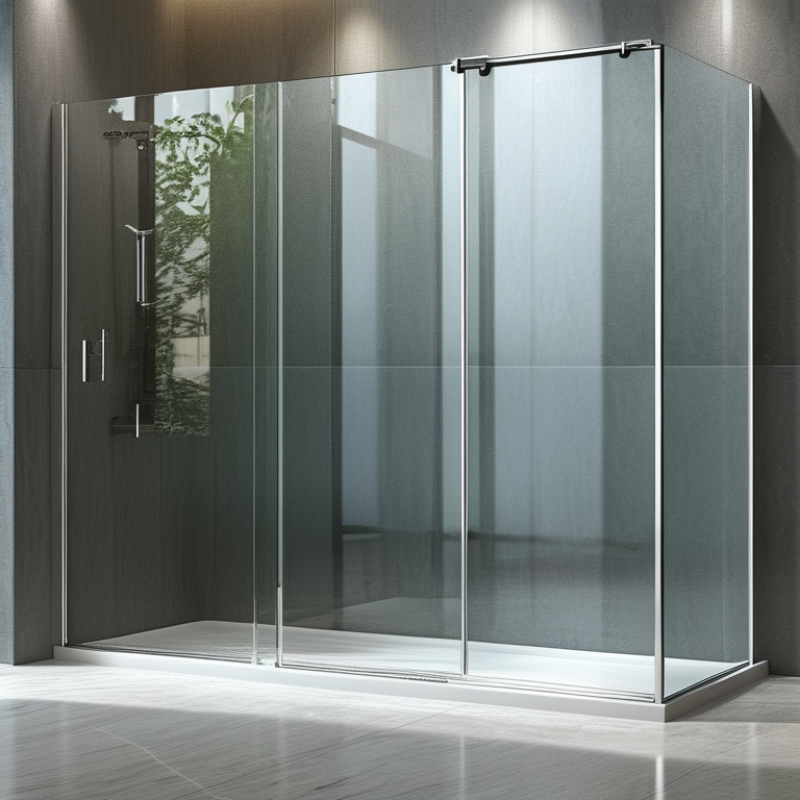
Shower Systems With Glass: Product Types and Key Features
Shower systems with glass combine enclosure design, water control, and daily comfort. Common options include framed enclosures, semi-frameless doors, frameless panels, and walk-in showers. Sliding doors suit compact bathrooms, while hinged doors need clear opening space. Curved glass can improve movement around corner installations.
Glass quality deserves close inspection. Tempered safety glass is widely used because it resists ordinary impact and breaks into smaller pieces if damaged. Thickness often ranges from 6 to 10 millimeters, depending on the structure and installation method.
Clear glass keeps a small bathroom bright. Frosted or patterned glass offers more privacy, but it may require more cleaning. Low-maintenance coatings can reduce water spots, although they are not maintenance-free.
Hardware affects the system’s lifespan. Stainless steel hinges, handles, rollers, and wall channels should feel solid and move smoothly. Seals must close evenly without squeezing out of position. During supplier evaluations, request glass thickness records, edge-processing details, load-test information, and packaging photographs.
A careful factory should also explain tolerances and replacement procedures. One detail is often missed: the bathroom floor must be checked before production. Poor drainage can make a well-built enclosure perform badly.
Small details matter. Some product drawings look precise, yet installation notes may remain incomplete. Reviewing samples, inspection reports, and assembly instructions can reveal that weakness before shipment.
How to Evaluate Chinese Shower With Glass Manufacturers
When evaluating Chinese shower with glass manufacturers, begin with product evidence, not showroom images. Grand View Research estimated the global shower enclosure market at about USD 4 billion in 2023. That scale attracts capable factories and inconsistent suppliers. Ask for the factory’s legal production scope, quality system records, and recent inspection reports. Confirm whether the glass is tempered, laminated, or untreated. Request thickness data, edge-finishing details, and heat-soak testing records. Standards such as EN 12150 and ANSI Z97.1 can guide your technical review.
Audit the production line if possible. Check cutting tables, tempering furnaces, silicone storage, and final inspection stations. A reliable manufacturer should trace each panel by batch number. Test sample doors for alignment, leakage, roller movement, and hardware corrosion. ASTM market guidance stresses repeated performance testing for shower enclosure components, not visual inspection alone. The supplier’s certificate may be genuine, but it may cover another product. That mistake is common. I would also compare the approved sample with mass-production units, because small hardware changes can affect installation.
Tips: Ask for three recent export references, anonymized if necessary. Require a written tolerance sheet. Photograph packed cartons before shipment. Review replacement-glass procedures before signing. The 2024 ISO Survey shows ISO 9001 remains widely adopted worldwide, but certification alone does not guarantee careful workmanship. Factory communication matters too. Slow replies, unclear drawings, or unexplained price changes deserve attention. A lower quotation can hide thinner glass, weaker rollers, or incomplete packaging.
Manufacturing Standards, Materials, and Quality Control
China Top Shower With Glass Manufacturers and Suppliers?
Manufacturing Standards, Materials, and Quality Control
Reliable glass shower manufacturers build around documented standards, not attractive catalogs alone. Tempered glass should meet recognized safety requirements, such as EN 12150 or ANSI Z97.1. The correct standard depends on the destination market. Every panel needs consistent thickness, smooth edges, and accurate drilling. Small defects spread. They can become installation problems later.
Material selection also affects service life. Common hardware uses 304 stainless steel, while humid coastal projects may require 316 stainless steel. Brass fittings can offer strength when their plating is properly controlled. Seals should resist water, aging, and repeated compression. Silicone and EPDM remain practical choices for many shower systems. Factory quality control should cover incoming materials, cutting, tempering, assembly, and final inspection. Checks may include glass surface inspection, hardware measurement, door alignment, water testing, and repeated opening cycles. Traceable batch records help suppliers identify faults quickly.
A capable supplier should provide inspection reports, material details, tolerance data, and clear packaging procedures. Samples are useful, but mass production can reveal different weaknesses. Not always. Buyers should compare production samples with approved specifications, not verbal promises. No factory is flawless, and an honest supplier should explain its correction process. In practice, better results often come from small details: protected corners, separated glass panels, calibrated tools, and trained inspectors who record problems instead of hiding them.
China Top Shower With Glass Manufacturers and Suppliers? - Manufacturing Standards, Materials, and Quality Control
| Category | Manufacturing Dimension | Typical Specification or Benchmark | Applicable Standard or Reference | Quality-Control Method |
|---|---|---|---|---|
| Glass | Safety glass type | Heat-treated safety glass is commonly used for shower doors and enclosures; ordinary annealed glass is not recommended for these applications. | EN 12150-1, ANSI Z97.1, and applicable local building codes | Review of heat-treatment records, certification documents, visual inspection, and fragmentation testing |
| Glass | Glass thickness | Common shower enclosure thicknesses are 6 mm, 8 mm, and 10 mm; the selected thickness depends on panel size, support design, and installation method. | Project drawings, engineering calculations, and regional code requirements | Digital thickness measurement at multiple points and comparison with approved drawings |
| Glass | Glass edge and surface quality | Edges should be polished or properly finished, with no sharp chips, cracks, significant scratches, or unacceptable optical distortion. | Approved visual quality limits and applicable glass-processing specifications | Inspection under controlled lighting, edge-radius checks, and dimensional verification |
| Hardware | Frame and fitting material | Common options include 304 stainless steel, 316 stainless steel for more corrosive environments, anodized aluminum, and plated brass. | Material certificates, coating specifications, and approved bill of materials | Material composition verification, coating-thickness checks, dimensional inspection, and surface examination |
| Hardware | Corrosion resistance | Hardware should resist bathroom humidity, water exposure, and cleaning chemicals; stainless steel grade and surface finish influence service life. | ASTM B117 or ISO 9227 salt-spray testing when specified by the project | Salt-spray exposure, humidity testing, and post-test inspection for corrosion or coating failure |
| Sealing | Gaskets and seals | EPDM, PVC, or silicone seals are commonly used; profiles should fit the specified glass thickness and maintain contact after repeated door movement. | Approved material specification and project water-containment requirements | Profile-size measurement, elasticity inspection, compression-fit check, and water-leak testing |
| Dimensions | Panel size and squareness | Panel dimensions, hole positions, notches, and clearances should match approved shop drawings; tolerances must be defined before production. | Approved technical drawings and agreed manufacturing tolerances | Caliper, tape, height gauge, diagonal measurement, and template inspection |
| Door Function | Opening, closing, and alignment | Doors should operate smoothly without binding, excessive noise, unstable movement, or interference with adjacent panels. | Approved assembly drawings and functional inspection criteria | Repeated open-close cycling, hinge or roller adjustment check, and clearance inspection |
| Water Management | Water containment | Joints, seals, thresholds, and door overlaps should direct water toward the shower area and minimize leakage under normal use. | Project-specific water-test procedure and installation instructions | Controlled spray test, visual leak inspection, and drainage-path verification |
| Production System | Process traceability | A documented quality system should link raw materials, glass processing, hardware batches, inspection results, and final packaging to a production order. | ISO 9001 quality-management principles and customer-specific requirements | Batch records, inspection checklists, nonconformity reports, and corrective-action review |
| Packaging | Protection during transport | Glass should be separated with suitable protective materials, while corners, edges, hardware, and fittings require additional cushioning and moisture protection. | Approved packaging specification and applicable export-transport requirements | Packaging inspection, carton or crate dimension check, label verification, and simulated handling review when required |
Note: Specifications and test requirements should be confirmed against the destination market, project drawings, installation conditions, and the latest applicable standards.
Supplier Capabilities, Customization, and Order Requirements
China Top Shower With Glass Manufacturers and Suppliers?
Reliable shower suppliers should show more than attractive product photos. Check their glass processing, metal finishing, assembly, and quality-control capacity. Tempered glass should have consistent thickness, clean edges, and documented safety testing. Ask whether the supplier handles cutting, drilling, polishing, and hardware installation in-house. Factory audits, production samples, and inspection records provide stronger evidence than promises.
Customization requires precise communication. Provide drawings, glass dimensions, color references, hardware preferences, packaging needs, and installation conditions. Confirm minimum order quantities, sample charges, tooling costs, production lead times, and payment stages before approval.
Also ask about replacement parts and damage claims. A low quotation may hide weak packaging or uncertain tolerances. That mistake becomes expensive after shipment. Specifications can still be incomplete, so review every revision carefully.
Tips: Request one finished sample before bulk production. Compare its door alignment, sealing strips, surface finish, and carton protection. Use a written purchase specification with signed drawings. Confirm shipping marks and pallet requirements early. Do not rely on verbal changes. A second inspection is often worthwhile. Could it be excessive? Sometimes, but one broken glass panel can disrupt an entire installation schedule.
Pricing, Certifications, and Export Support in China
China Top Shower With Glass Manufacturers and Suppliers?
Pricing depends on glass thickness, enclosure size, hardware grade, packaging, and order volume. An 8mm tempered glass enclosure usually costs more than a 6mm model. Custom finishes and reinforced cartons also increase the factory price. Ask for EXW, FOB, and CIF quotations separately. Shipping can change the final cost sharply.
A dependable supplier should provide glass test reports and documents matching your destination market. Common evidence includes tempered-glass safety testing, factory quality records, and an ISO 9001 certificate. However, ISO 9001 confirms management processes, not automatic product compliance. Check the actual standard, laboratory, test date, and product scope. Do not accept a certificate image without verification.
Export support matters after production. Experienced teams can prepare commercial invoices, packing lists, certificates of origin, and loading photos. They should confirm pallet dimensions and container capacity before payment. Request a pre-production sample or a small trial order. It exposes problems with door alignment, seal quality, and surface scratches. A low quote may hide weak packaging or expensive replacement parts. This is easy to overlook. Factory audits, video inspections, and third-party checks add practical protection. Still, no supplier can remove every risk. Agree on tolerances, inspection timing, warranty terms, and spare-part availability in writing. Proper communication is often more valuable than a polished catalog.
Article Source:
Contact us
Please fill out the enquiry form, and our dedicated team will promptly attend to your request