China Top 10 Electric Pallet Jacks Suppliers?
Choosing among China’s top 10 Electric Pallet Jacks suppliers requires more than comparing catalog prices. It demands evidence from factory audits, battery specifications, service records, and real warehouse performance. Electric pallet jacks now move heavier loads through narrower aisles, cold rooms, retail backrooms, and busy distribution centers. Their value appears in small details: smooth acceleration, reliable emergency stops, low handle vibration, and batteries that survive a full shift.
Industry forecasts show strong but inconsistent growth. Grand View Research estimates that the global electric pallet truck market reached approximately USD 5.55 billion in 2023, with expansion expected through 2030. Fortune Business Insights reports a smaller market baseline, yet also projects steady growth during the same period. The difference is important. Market definitions vary, and some reports combine walkie pallet trucks with larger electric models. Readers should question impressive figures.
Logistics scholar Martin Christopher’s well-known observation, “Supply chains compete, not companies,” offers a useful perspective. A supplier’s competitiveness depends on the entire support chain, not only the machine. This guide therefore examines manufacturers through product range, rated capacity, lithium-battery options, charging systems, customization ability, export experience, certifications, and after-sales responsiveness. Supplier claims still require verification. A polished website proves very little.
Some factories excel at volume but provide limited technical documentation. Others offer strong engineering but weaker overseas support. That tension matters for importers, warehouse operators, and equipment distributors. The following overview highlights leading Chinese suppliers while acknowledging a practical limitation: rankings can change with region, order size, and evaluation method. Real performance is always more complicated than a sales brochure.
What Are Electric Pallet Jacks and How Do They Work?
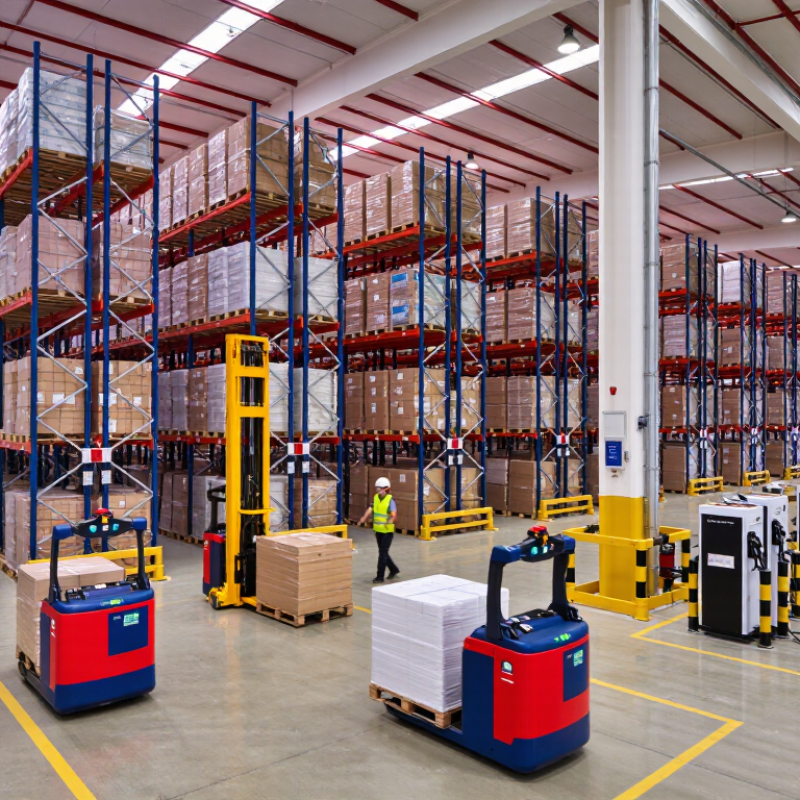
An electric pallet jack is a battery-powered warehouse vehicle for moving palletized loads. It uses an electric motor, drive wheel, forks, and control tiller. The operator walks behind it or rides on a small platform. A rechargeable battery supplies energy to the drive and lifting systems. Pressing the throttle sends power to the drive wheel. Pressing the lift button raises the forks through a hydraulic pump. Releasing the controls normally stops movement and lowers risk during handling.
In practical warehouse work, electric pallet jacks suit short-distance transport, loading areas, and narrow aisles. Their compact frames reduce physical pushing, especially with heavy pallets.
OSHA reports about 35,000 serious powered-industrial-truck injuries annually in the United States. Pallet-jack operation still requires training, visibility checks, and controlled speed.
A 2024 Grand View Research analysis projects strong growth for the global electric pallet truck market through 2030, supported by warehouse automation and e-commerce. Market estimates differ between research firms. That difference deserves attention.
Battery capacity, floor condition, load weight, and charging habits can change real productivity. A model rated for two tonnes may perform poorly on uneven floors or long ramps.
Operators should check the load center, fork condition, emergency stop, and battery cables before each shift. Small faults become expensive quickly.
Why Choose Chinese Electric Pallet Jack Suppliers?
Chinese electric pallet jack suppliers attract global buyers because they combine manufacturing scale, practical engineering, and flexible production. Many factories produce motors, controllers, batteries, and frames within established industrial networks. This can shorten lead times and simplify replacement-part sourcing. That matters.
Buyers can often request useful details, such as a shorter fork length, reinforced wheels, or a battery suited to a cold warehouse. Suppliers may also support sample testing, operator training materials, and customized packaging. During equipment evaluations, I would inspect welding points, steering response, braking distance, and lifting stability under a realistic load. A polished brochure is not enough. Ask for test records, component specifications, factory photographs, and clear warranty terms.
Chinese manufacturers also serve demanding export markets, giving many teams experience with documentation, quality inspection, and logistics coordination. Still, price should never carry the decision alone. A low quotation may hide weaker batteries, limited service coverage, or unclear spare-parts support. Look closely. Request a video demonstration with a visible load and continuous operating time. Independent inspection is worthwhile before shipment, especially for large orders. Some suppliers communicate quickly but provide vague technical answers. That is a warning worth considering. A reliable partner explains limitations, admits production constraints, and offers a practical remedy instead of promising perfection.
How to Evaluate the Top 10 Chinese Suppliers
When comparing China’s top 10 electric pallet jack suppliers, treat rankings as a starting point, not proof. A polished website cannot replace factory evidence. Request production photos, quality records, and a live video inspection. Check whether the supplier designs, assembles, and tests the equipment directly. This distinction matters when replacement parts are urgently needed.
Evaluate each pallet jack against your actual warehouse conditions. Confirm rated load, lifting height, turning radius, fork dimensions, and battery working time. Ask for test data under realistic loads, not only laboratory figures.
Inspect welds, control handles, wheels, emergency switches, and charger protection. A sample unit can reveal loose wiring or noisy movement. Small defects often become expensive during daily operation.
Reliable suppliers explain applicable safety standards and provide complete technical documents. They should also offer clear warranty terms, spare-part availability, operator manuals, and response times. Contact recent customers, preferably in similar climates and warehouse environments. Ask how complaints were handled, not just whether customers were satisfied. Price deserves attention, but an unusually low quotation may hide weaker batteries, limited testing, or unclear service responsibilities. No supplier is perfect. I would keep a scoring sheet and record every unanswered question. My own evaluation could still miss hidden production changes, so periodic rechecking remains necessary.
China’s Top 10 Electric Pallet Jack Suppliers Compared
China’s top 10 electric pallet jack suppliers differ in more than price. A useful comparison should examine factory experience, production capacity, testing methods, and export support. Some suppliers focus on compact warehouse models, while others build heavy-duty units for distribution centers.
For a fair review, compare rated load, fork dimensions, turning radius, battery type, and charging time. A 1.5-ton pallet jack may suit narrow aisles, but it can struggle on uneven floors. Lithium batteries reduce daily handling, although replacement costs may be higher. Ask for test records, wiring diagrams, spare-parts lists, and clear warranty terms. These details often reveal more than a polished catalog.
Factory audits also matter. Check assembly lines, weld quality, brake response, and emergency-stop performance. Confirm whether quality control covers every unit or only sample batches. Suppliers with documented inspections and trained service teams usually manage overseas orders more reliably. Still, no ranking stays accurate forever. A supplier may offer excellent equipment but respond slowly after delivery. Another may provide fast support but limited customization. Request a video inspection and a sample machine before placing a large order. Small defects, such as loose tiller buttons or uneven wheel wear, become expensive when multiplied across a fleet.
What Should Buyers Check Before Placing an Order?
When comparing China’s top 10 electric pallet jack suppliers, buyers should inspect performance, not catalogue promises. The 2024 MHI Annual Industry Report identifies labor shortages and rising service expectations as major supply-chain pressures. That makes uptime, safe handling, and simple maintenance important purchasing tests.
Check the rated load, lift height, turning radius, and residual capacity at full lift. Ask for battery-cycle data under your actual workload. Lithium batteries may reduce charging interruptions, but charger compatibility and replacement cost still matter. Request inspection records, load-test results, CE or equivalent conformity documents, and manuals in clear English. ISO 3691-1 provides useful safety requirements for industrial trucks. The Global Battery Alliance also stresses traceability and responsible battery supply chains. A low quotation can look clever. It may hide weak after-sales support.
Tips: Ask for a video test with your pallet dimensions and floor conditions. Confirm spare-parts availability, technician response time, warranty exclusions, and software access. Calculate total cost over five years, including batteries, chargers, tires, training, and downtime. Interact Analysis reported continuing investment in warehouse automation through 2024, yet automation only works when equipment fits the site. I have seen buyers focus too heavily on motor power. That is an imperfect measure. A quieter machine with better braking and balanced controls may deliver safer daily work. Insist on a sample unit or site trial before placing a large order.
