How to Choose a Cereal Bar Machine for Your Business?
Choosing a Cereal Bar Machine is a production decision, not simply a price comparison. The right equipment must match your recipe, output target, bar dimensions, and packaging line. A soft oat bar behaves differently from a dense nut-and-seed bar. That difference affects mixing force, forming pressure, cooling time, and cutting accuracy.
Market evidence supports careful planning. Grand View Research’s 2024 cereal bars market analysis expects steady mid-single-digit growth through 2030. This signals opportunity, but growth alone does not justify buying the largest machine. PMMI’s 2024 packaging industry research also emphasizes labor availability, equipment flexibility, automation, and faster changeovers. These issues appear on the factory floor. Operators may handle sticky syrup, adjust roller gaps, or clean narrow product channels during a busy shift. Small design details matter.
Start with measurable production facts. Record your target kilograms per hour, bar length, thickness, moisture level, and recipe temperature. Then compare forming systems, heating control, conveyor width, cutting precision, sanitation access, and spare-parts support. Ask suppliers for verified test results using your actual mixture. Brochures can look impressive. Your recipe may disagree.
Food safety should remain central. Review hygienic design, stainless-steel contact surfaces, cleanability, guarding, electrical standards, and documented quality procedures. Consider total ownership cost, including energy, maintenance, downtime, labor, and rejected bars. A low purchase price can become expensive after repeated adjustments. However, an advanced machine may also be excessive for a small workshop. That is the uncomfortable part. The best choice is rarely the most powerful option; it is the one that performs reliably within your real operating conditions.
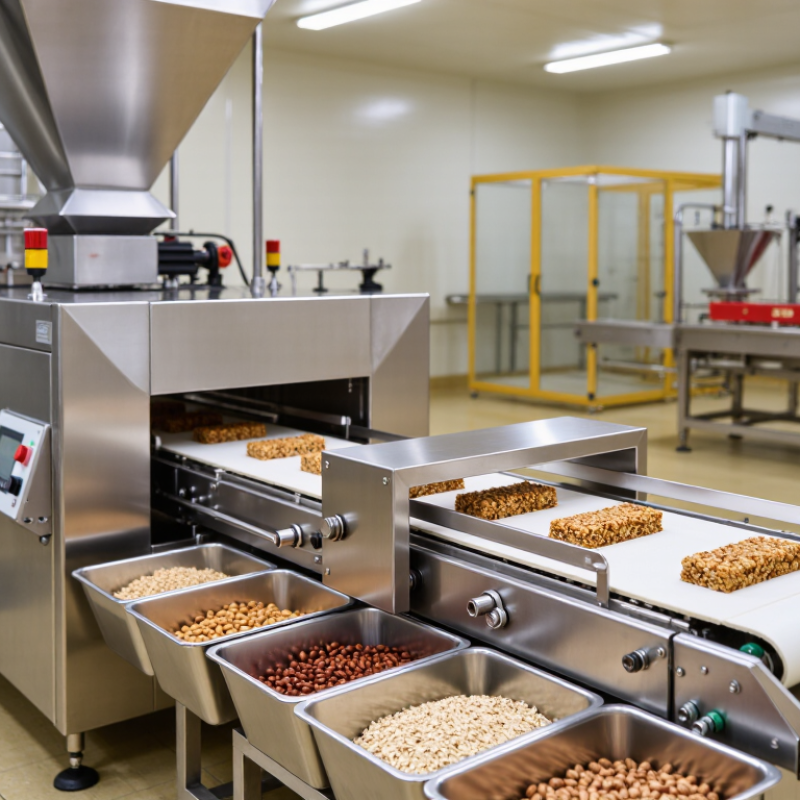
Understand Your Cereal Bar Production Requirements
Choosing a cereal bar machine starts with understanding your production requirements. Estimate daily output, peak-hour demand, and the bar size you plan to sell. A small bakery may need 300 bars per hour, while a larger facility may require several thousand. Record the recipe carefully. Syrup thickness, grain size, nuts, dried fruit, and moisture levels can affect forming pressure and cutting accuracy.
Your machine should match the texture of your product. Soft bars may need gentle compression, while firm bars require stronger pressing and controlled heating. Check the feeding system, cutter dimensions, cooling space, and conveyor speed. Easy access for cleaning matters too. Operators lose time when sticky residue builds around rollers and guides. I once underestimated changeover time; the production plan looked efficient, but cleaning took nearly twice as long.
Tips:
Run a realistic test batch before purchasing. Use your actual ingredients, not a substitute mixture. Measure bar weight, thickness, breakage, and production speed. Ask for maintenance records, training details, and spare-part availability. Confirm that temperature controls remain stable during continuous operation. Leave room for future growth, but avoid paying for capacity you cannot use. A machine that works well in a demonstration may behave differently during a full shift. Review the results with operators, because their practical feedback often reveals problems that specifications miss.
Compare Machine Types, Features, and Production Capacities
Choosing a cereal bar machine starts with product texture, not speed. Slab-forming lines suit soft oat mixtures and rectangular bars. Extrusion systems handle denser recipes with nuts, seeds, or high-protein ingredients. A cut-and-wrap line works well for simple shapes and moderate output. According to Grand View Research’s 2024 cereal bar analysis, the market is projected to grow at over 5% annually through the decade. That growth can reward flexible equipment, but only if changeovers remain practical.
Compare production capacities carefully. Small servo-driven lines may produce 30–80 bars per minute. Larger automated systems can exceed 300 bars per minute, depending on bar size, recipe, and wrapping format. These figures are not directly comparable. A 40-gram bar and a 70-gram bar consume different forming and cooling time. PMMI industry reports repeatedly identify labor availability and automation as major packaging concerns. Therefore, inspect automatic feeding, vision inspection, metal detection integration, and tool-free cleaning features. Stainless-steel contact parts matter when sticky syrup coats the conveyor.
Tips: Request a live test with your own mixture. Measure weight variation, breakage, cooling time, and film waste. Ask for output at realistic operating speeds, not only the maximum rate. My first capacity estimate was too optimistic; recipe temperature changed the result. Leave room for seasonal products and future pack sizes. A cheaper machine may become expensive when one operator cannot manage feeding, forming, wrapping, and sanitation. Consider spare-part access and service response before signing.
Evaluate Bar Size, Shape, Ingredients, and Product Flexibility
Choosing a cereal bar machine starts with the bar you intend to sell.
Size and shape affect forming pressure, cooling time, and wrapping speed. A 25-gram rectangular bar may need different compression than a 45-gram round bar. Small errors become expensive.
During trials, weigh at least 30 pieces from each batch. Record thickness, breakage, and moisture. These measurements show whether the machine is stable, not merely fast.
The 2024 IFIC Food & Health Survey reported that 73% of American respondents snack at least twice daily. That frequency supports demand for convenient bar formats, but convenience does not mean uniform recipes.
Sticky dates, nuts, puffed grains, and protein crisps behave differently in a feeder and forming chamber. Choose equipment with adjustable pressure, feeder speed, and cutting length. The machine should also support quick cleaning between recipes.
According to Grand View Research’s 2024 Snack Bars Market report, the market was valued at approximately 24.43 billion dollars in 2023. Flexibility can protect future product development.
My first instinct was to prioritize maximum output. That assumption needed testing. A slower machine produced cleaner edges and fewer broken bars during one pilot run.
Ask suppliers for trials using your actual ingredients, not sample material. Test narrow and wide bars, soft and crunchy formulas, and at least two shapes.
Check weight variation, changeover time, waste, and operator workload. A machine that handles only today’s recipe may become a costly limitation.
Check Automation, Cleaning, Safety, and Maintenance Needs
How to Choose a Cereal Bar Machine for Your Business?
Automation should match your actual production rhythm, not a sales forecast. Check output speed, recipe control, changeover time, and integration with weighing and packaging equipment. The International Federation of Robotics reported 541,302 industrial robots were installed worldwide in 2023. That growth supports automation, but a fully automated line may exceed a small factory’s needs.
Cleaning deserves equal attention. Choose stainless-steel contact surfaces, open frames, sloped areas, and tool-free removal of cutters and guides. Ask how long a complete sanitation cycle takes. CDC estimates that foodborne illnesses affect about 48 million people in the United States annually. Poorly accessible surfaces create avoidable contamination risks. They also increase labor costs. A machine can look hygienic and still hide residue beneath a conveyor.
Safety and maintenance must be tested before purchase. Confirm guarding, interlocked doors, emergency stops, and lockout points. Operators should reach controls without stepping across moving parts. Request maintenance records from a comparable installation. PMMI’s industry reports consistently identify labor availability and equipment reliability as major packaging concerns. Keep that warning practical. Does the supplier provide fault diagnostics, wear-part lists, training, and local technical support? I would not choose a machine based only on hourly capacity. A slightly slower line may perform better when cleaning is faster and breakdowns are easier to diagnose. Schedule preventive inspections for bearings, belts, sensors, and heating elements. That schedule may change after real production begins.
How to Choose a Cereal Bar Machine for Your Business? - Check Automation, Cleaning, Safety, and Maintenance Needs
| Selection Factor | What to Check | Practical Reference or Requirement | Priority | Recommended Evaluation Method |
|---|---|---|---|---|
| Production Capacity | Rated output of the complete line, including forming, cooling, cutting, and transfer sections. | Choose capacity from actual demand plus approximately 15–25% headroom. Confirm output in bars per minute and kilograms per hour. | High | Calculate required output from sales forecasts, working hours, product weight, and expected downtime. Request a production test using the intended recipe. |
| Automation Level | Availability of automatic feeding, syrup or binder dosing, slab forming, cooling, cutting, conveying, and recipe control. | A semi-automatic line may suit varied or smaller batches. A continuous automatic line is more suitable for stable, high-volume production. | High | List every manual intervention and estimate labor hours per shift. Check whether recipes, speed, temperature, and alarms can be controlled from one interface. |
| Product Flexibility | Compatibility with different bar weights, sizes, ingredients, binder viscosities, inclusions, and coating options. | The machine should support the required product range without lengthy mechanical changes or unstable feeding of nuts, seeds, fruit, or crisped grains. | High | Test the smallest and largest planned formats, plus recipes with sticky binders and fragile inclusions. Record changeover time and product loss. |
| Cleaning and Sanitation | Food-contact materials, access to conveyors and hoppers, removable parts, drainage, dead zones, and tool requirements. | Prefer stainless-steel food-contact surfaces, smooth welds, accessible inspection points, and removable components that can be cleaned without excessive dismantling. | High | Ask for a documented cleaning procedure. Time a full changeover cleaning and verify that residue cannot collect around scrapers, rollers, seals, or transfer points. |
| Food Safety and Hygiene | Hygienic design, allergen changeover controls, foreign-material prevention, lubrication controls, and traceable operating parameters. | Use food-grade lubricants where incidental contact is possible, segregate allergen-containing ingredients, and maintain records for cleaning and process checks. | High | Review the hazard analysis, material certificates, lubricant specifications, allergen procedure, and sanitation verification records before purchase. |
| Operator Safety | Guarding, interlocked access doors, emergency stops, hot-surface protection, pinch-point controls, and electrical protection. | All moving and hot areas should be guarded. Opening an interlocked guard should stop the relevant hazardous motion, and emergency stops should be accessible. | High | Perform a site-specific risk assessment. Test emergency stops and interlocks during commissioning and confirm that safety devices cannot be easily bypassed. |
| Temperature and Process Control | Accuracy and stability of binder heating, cooling tunnels, temperature sensors, and control alarms. | Temperature settings must match the recipe and remain stable enough to prevent poor binding, excessive stickiness, melting, or brittle bars. | High | Compare displayed and independently measured temperatures at normal operating speed. Check alarm limits, data logging, and recovery after short interruptions. |
| Cutting Accuracy | Cut length consistency, blade or wire adjustment, crumb generation, and performance with soft or hard products. | Cutting should maintain the required bar dimensions and weight tolerance while minimizing cracks, deformation, and loose crumbs. | Medium | Weigh and measure a representative sample from the beginning, middle, and end of a trial run. Record rejects and rework rates. |
| Changeover Time | Time required to change product dimensions, recipe settings, tooling, film, or packaging format. | Short, repeatable changeovers reduce downtime. Tool-free or quick-release adjustments are useful for frequent product changes. | Medium | Conduct a timed changeover with the same number of operators expected in production. Include cleaning, adjustment, calibration, and first-good-product time. |
| Maintenance Access | Access to bearings, belts, chains, heaters, sensors, pumps, cutters, seals, and electrical panels. | Routine service points should be reachable without removing large assemblies. Preventive maintenance tasks should have clear intervals and instructions. | High | Request maintenance drawings, lubrication points, service intervals, spare-parts lists, and an estimated time for common repairs. |
| Spare Parts and Technical Support | Availability of wear parts, response time, remote support, training, documentation, and local service capability. | Keep critical wear parts such as seals, belts, blades, sensors, and bearings available according to usage and lead-time risk. | High | Obtain a two-year spare-parts recommendation, warranty terms, training scope, and support escalation process in writing. |
| Energy and Utilities | Electrical load, heating method, compressed-air demand, cooling-water requirements, ventilation, and exhaust needs. | Utility requirements must match the facility. Include startup load and peak demand, not only average running consumption. | Medium | Compare the equipment utility schedule with available site capacity. Estimate energy cost per kilogram using expected operating hours. |
| Floor Space and Layout | Overall footprint, operator clearance, cleaning access, material flow, product flow, and future expansion space. | Allow safe access around the line and separate raw-material, processing, finished-product, and waste flows where required by the site hygiene plan. | Medium | Create a scaled layout showing utilities, walkways, maintenance zones, ingredient staging, packaging, and emergency access before ordering. |
| Total Cost of Ownership | Purchase price, installation, tooling, utilities, labor, cleaning, spare parts, downtime, and planned upgrades. | The lowest purchase price may not provide the lowest operating cost. Compare cost per acceptable bar over the expected service life. | High | Build a three- to five-year cost model using realistic output, labor, energy, maintenance, waste, and downtime assumptions. |
Calculate Costs, Space Requirements, and Long-Term Business Value
A cereal bar machine should be judged by total ownership cost, not its purchase price. Start with realistic demand. For example, a line producing 80 bars per minute, operating eight hours daily for 250 days, could make 9.6 million bars yearly. That output is useless if sales reach only half that level. Calculate product cost, labor, packaging, maintenance, energy, rejected bars, and financing. My first spreadsheet usually looks too optimistic.
Space planning needs more than the machine’s footprint. Leave room for ingredient loading, cleaning, inspection, mold changes, and safe operator movement. A 4-meter machine may require 8 to 10 meters of practical working length. Confirm floor loading, electrical capacity, compressed air, drainage, and ventilation before ordering. The U.S. Department of Energy reports that compressed-air leaks can waste 20% to 30% of compressor output. Small leaks become expensive over long shifts.
Long-term value depends on flexibility. PMMI’s 2024 State of the Industry report identifies labor availability and equipment flexibility as continuing packaging investment drivers. Choose adjustable forming, cutting, and cooling controls when recipes may change. Record expected uptime, changeover minutes, spare-part costs, and technician response time. Then test the calculation under lower sales, higher energy prices, and two weeks of downtime. It may fail. That failure is useful. A cheaper machine can become costly when it creates uneven weights, frequent cleaning delays, or excessive product waste. Use supplier trials and documented production data before signing.
How to Choose a Cereal Bar Machine for Your Business?
Compare estimated five-year ownership costs, production capacity, and floor-space requirements before investing in a cereal bar production line.
Best for small batches and market testing. Lower capital cost, but limited output and more manual handling.
A practical balance of throughput, automation, footprint, and long-term operating cost for growing businesses.
Designed for large production volumes. Higher investment and space requirements can be justified by greater capacity.
Planning estimates assume one production shift, 250 operating days per year, and include equipment, installation, energy, routine maintenance, and basic tooling over five years. Actual costs vary by configuration, labor rates, utilities, and local regulations.
Article Source:
Contact us
Please fill out the enquiry form, and our dedicated team will promptly attend to your request